The model for H2 imports and exports#
PyPSA-Spain includes a functionality to model hydrogen imports and exports through cross-border points. Each import/export point represents a fixed annual amount of hydrogen flowing in or out of the Spanish system at a given geographical location, typically associated with a planned or existing transboundary H2 infrastructure (e.g. a pipeline corridor).
The required elements are added during the rule prepare_sector_network, after the regular sector-coupled network has been built. The configuration relies on two groups of elements: a YAML file describing the cross-border points, and a corresponding entry in the pypsa_spain module of the configuration file.
Model components#
For each cross-border point, the following elements are added to the network:
a border H2 bus with carrier
H2_icand unitMWh_LHV, located at the user-specified coordinates.if the point represents an import: a must-run generator at the border bus, producing a constant power output such that the total annual production equals the configured amount of hydrogen.
if the point represents an export: a fixed load at the border bus, consuming a constant power such that the total annual consumption equals the configured amount of hydrogen.
a link between the border bus and the closest H2 bus of the Spanish network. The direction of the link reflects the flow direction (border → network for imports, network → border for exports). The link uses carrier
H2_ic importorH2_ic exportaccordingly.
The closest H2 bus is identified at runtime based on Euclidean distance between the border coordinates and the buses in peninsular Spain.
The annual hydrogen amount is converted to a constant power setpoint using:
where \(33.33 \times 10^6\) MWh is the lower heating value of one million tonnes of H2, and \(\sum_t w_t\) is the total weight of the snapshots (equal to 8760 hours for full-year runs at any temporal resolution).
The must-run behaviour of the generator is enforced through p_min_pu = p_max_pu = 1 and p_nom = p. The constant load is imposed by directly setting loads_t.p_set for the load.
Configuration#
The functionality is enabled in the pypsa_spain module of config/config_ES.yaml:
H2_imports_exports:
  enable: true
  file: data_ES/H2/H2_imports_exports.yaml
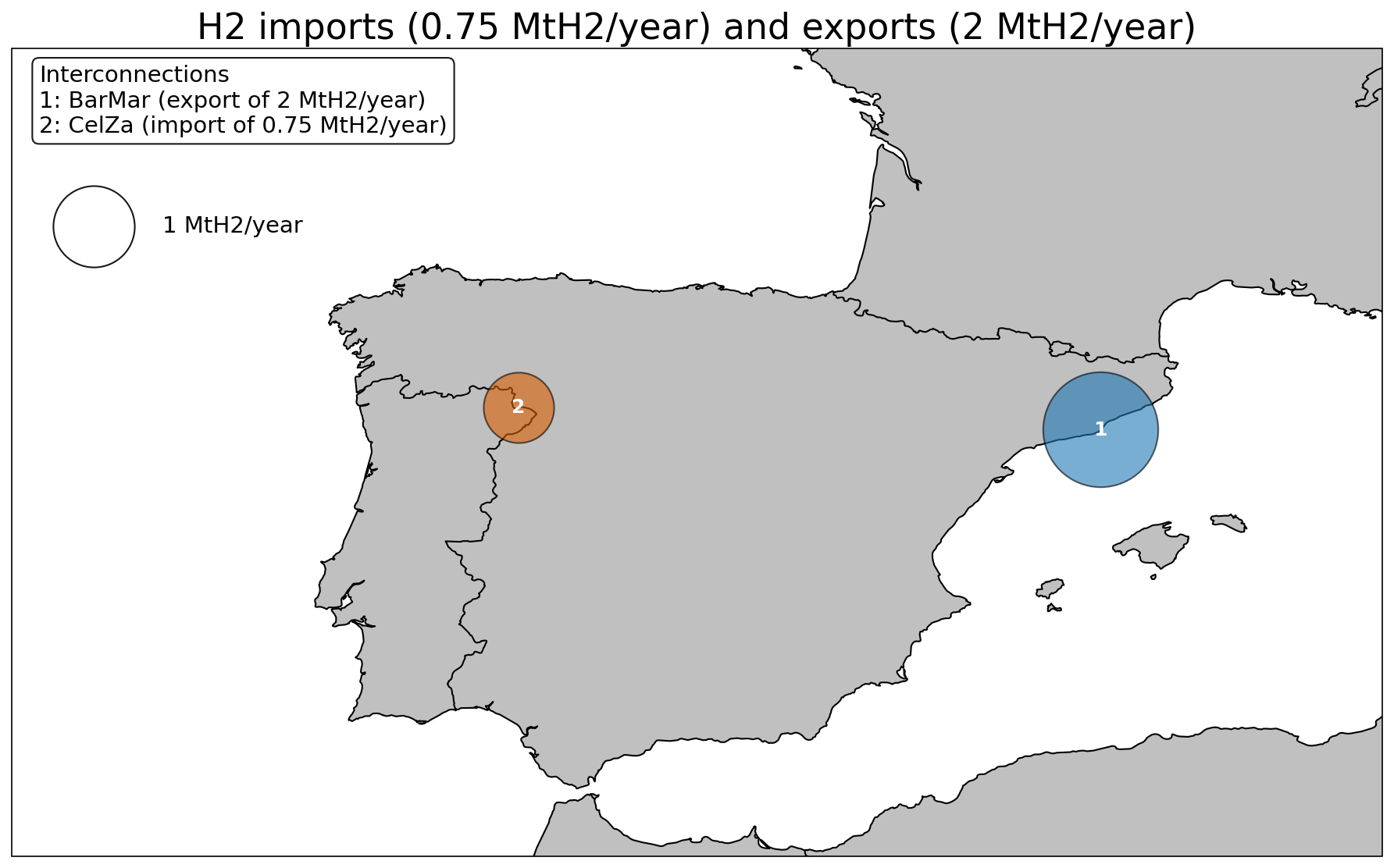
The characteristics of each cross-border point are defined in the file referenced above. Two example points are provided by default:
CelZa (import): a 0.75 MtH2/year hydrogen pipeline import from Portugal at the Iberian border (Zamora area).
BarMar (export): a 2 MtH2/year hydrogen pipeline export to France through the Mediterranean corridor (Barcelona area).
Modelling assumptions and limitations#
The current implementation deliberately abstracts away physical losses on the border-to-network link:
The link uses
efficiency = 1and is not subject to the compression losses applied to internal H2 pipelines (which act on the carrierH2 pipeline).The link capacity is fixed (
p_nom_extendable = False) and equal to the constant power required to satisfy the annual amount, ensuring the link never becomes a binding constraint.